
Why complex RFPs need strategic leadership, not just excellent proposal writing.
An important RFP arrives at your organization.
Someone takes responsibility for the response. A timeline is established, requirements are assigned, subject matter experts are contacted, and the team begins preparing the proposal.
Production has an owner.
But who owns the strategy?
Who is responsible for understanding the buyer beyond what's written in the RFP? Investigating the competition? Determining how your organization should differentiate itself? Identifying what evidence will make your position credible?
And who makes sure those findings actually influence the response?
In some organizations, those responsibilities belong to an experienced capture manager or proposal leader. In others, they're distributed across sales, leadership, and subject matter experts.
Sometimes, they aren't clearly assigned at all.
That's the problem worth examining.
Organizations often establish accountability for producing an RFP response without establishing equally clear accountability for developing the competitive strategy behind it.
At Informed Pursuit, we believe that needs to change.
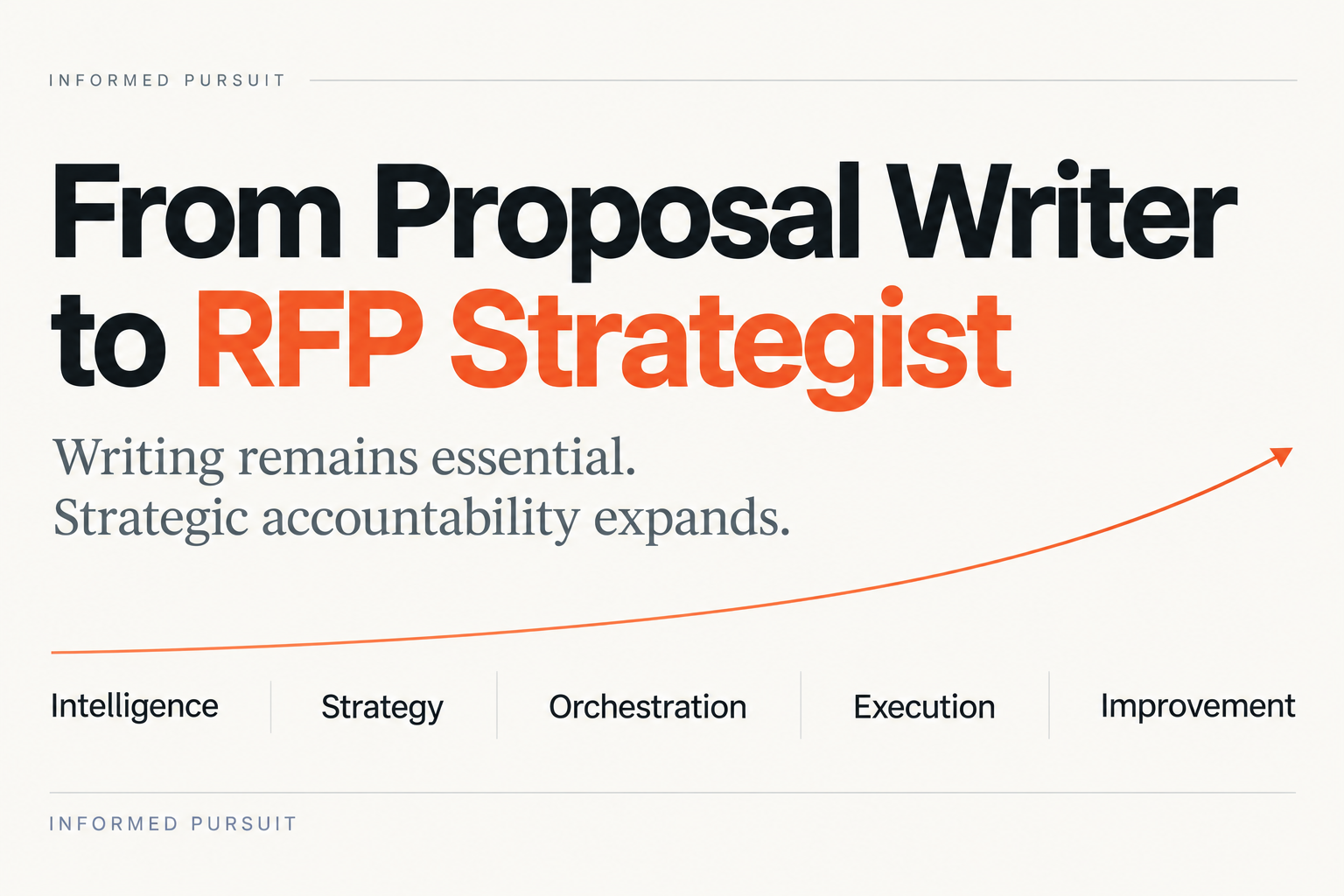
Our position is that organizations should consider evolving the traditional writing-centered role into an RFP strategist who leads the pursuit and also writes the response.
Not because proposal writing is unimportant.
Because writing is only one part of the work required to compete effectively.
When the Proposal Becomes the Process
Most organizations recognize that RFPs require more than writing.
They need information from sales, technical expertise, pricing decisions, leadership input, and careful review.
Yet the process often begins with the document.
The RFP is divided into sections. Questions are assigned. Existing content is retrieved. Contributors begin developing answers.
The team is moving, but several important questions may still be unresolved.
What is driving the buyer's decision?
What does the organization know about the incumbent?
Which competitors are likely to participate?
What advantages can the team substantiate?
How should those advantages influence the proposed solution?
Without clear strategic ownership, these questions can remain unanswered until drafting is underway.
Then the first substantial review begins.
Leadership questions the positioning. Sales introduces information about the buyer that wasn't incorporated. An expert identifies a commitment the organization can't support. Someone recognizes that a competitor may have a significant advantage.
The proposal goes back for revisions.
What looks like a writing problem may actually be a strategy problem.
The first draft has become the place where the organization figures out how it intends to compete.
That is an expensive way to develop strategy.
It consumes time, creates rework, and puts pressure on proposal professionals who are already managing demanding deadlines.
More importantly, it allows strategic decisions to emerge reactively rather than deliberately.
The solution isn't necessarily a better writer, a new template, or another software platform.
It starts with giving someone explicit responsibility for the pursuit strategy.
The Role Should Be Bigger Than the Document
An excellent proposal writer can transform complex information into clear, persuasive, compliant content.
That's a valuable skill.
But producing a strong document and developing a competitive pursuit are different responsibilities.
A proposal writer may be asked to explain why an organization's capabilities are valuable.
An RFP strategist should help determine which capabilities matter most to this buyer, how they compare with available alternatives, and what evidence supports the organization's position.
The difference isn't simply how well the response is written.
It's the work that informs what gets written.
What is an RFP strategist?
An RFP strategist is a professional responsible for developing and coordinating the strategy behind a competitive pursuit.
The role combines opportunity assessment, buyer and competitor intelligence, strategic positioning, cross-functional coordination, response development, and performance improvement.
The strategist must be an excellent writer, but writing is not the role's primary accountability.
The strategist leads the pursuit. The proposal communicates the strategy.
This distinction changes how the organization defines success.
Instead of asking only whether the response was completed accurately and on time, the organization also evaluates whether the opportunity was properly assessed, the buyer was understood, a defensible strategy was established, and that strategy was carried through execution.
It moves the role from document production toward competitive leadership.
Five Responsibilities That Define a Strategist-Led Pursuit
At Informed Pursuit, we see five connected areas of accountability for the professional leading an RFP pursuit.
1. Intelligence: Understand the opportunity
The strategist investigates the buyer, its business environment, stakeholders, procurement history, and competitive landscape.
The objective isn't to collect as much information as possible.
It's to identify what matters to the pursuit, distinguish verified facts from hypotheses, and determine which findings could influence the organization's decisions.
2. Strategy: Determine how to compete
Research should lead to decisions.
The strategist helps establish whether the opportunity is worth pursuing, which buyer priorities deserve emphasis, how the organization can differentiate itself, and what evidence is required to support its position.
These decisions inform win themes, solution positioning, and response architecture.
3. Orchestration: Connect expertise and decisions
A complex pursuit requires contributions from multiple functions.
Sales, operations, finance, legal, compliance, subject matter experts, and executive leadership may all have important responsibilities.
The strategist coordinates their contributions, manages dependencies, identifies unresolved issues, and keeps the pursuit aligned.
Appropriate business owners retain authority over their decisions and approvals.
The strategist provides coordination and strategic continuity.
4. Execution: Develop the response
With sufficient strategic context established, the strategist leads response development.
Writing expertise, organizational content, subject matter knowledge, and approved AI capabilities become tools for communicating the strategy.
The strategist coordinates reviews, verifies evidence, addresses requirements, and helps preserve positioning through submission and finalist preparation.
5. Improvement: Learn from the outcome
The work shouldn't automatically end when the proposal is submitted.
Buyer feedback, competitive observations, win/loss findings, cycle time, rework, and response quality can all inform future pursuits.
The strategist helps turn those findings into improvements.
Together, these responsibilities establish a different operating model.
The strategist isn't simply responsible for getting the response written. They're responsible for developing and coordinating the pursuit that produces it.
The Most Important Research Is Often the Work Nobody Owns
Buyer and competitor intelligence are central to this approach.
They're also activities that can fall between organizational responsibilities.
Sales may possess relationship knowledge. Leadership may understand market positioning. Technical teams may know how the organization's capabilities compare with alternatives.
But who brings that information together?
Who investigates what's missing?
And who translates those findings into recommendations that change the response?
The RFP provides valuable information about requirements and evaluation criteria, but it may not explain the full business circumstances behind them.
A buyer requesting extensive transition planning might be concerned about operational disruption.
A requirement for detailed reporting could reflect dissatisfaction with visibility or accountability.
An emphasis on geographic coverage might indicate service consistency concerns.
These are possible interpretations, not established facts.
The strategist investigates the available evidence and determines what can reasonably be concluded.
Competitive intelligence adds another layer.
Who is the incumbent? What advantages might that relationship provide? Which competing organizations are likely to participate? What alternative approaches could influence the evaluation?
Then comes the critical question:
Where do the buyer's priorities, the competitive environment, and our organization's defensible strengths intersect?
That's where positioning begins.
Without that analysis, proposals often rely on familiar claims about experience, expertise, responsiveness, and exceptional service.
Those statements may be accurate.
But they don't necessarily explain why this buyer should choose one provider over another.
The strategist's responsibility is to establish a credible, buyer-relevant reason to choose the organization and ensure that the response demonstrates it.
What Changes When a Strategist Leads the Pursuit?
Consider a hypothetical example.
Your organization receives an RFP from a company that has recently expanded into several additional locations.
The RFP includes a requirement for a detailed implementation and transition plan.
The writing-centered approach
A proposal writer retrieves approved implementation content and develops a response describing the organization's experience, established processes, communication practices, and ability to manage complex transitions.
The answer is professional.
It's accurate.
It addresses the requirement.
But several competitors may describe similar capabilities.
The response explains what the organization does without establishing why its approach is particularly relevant to this buyer.
The strategist-led approach
The strategist begins by investigating the opportunity.
Available information about the buyer's expansion suggests that managing service continuity across multiple locations may be important.
That becomes a research hypothesis, not an assumed fact.
The strategist reviews the RFP for supporting evidence, investigates relevant organizational context, and identifies questions that may need clarification.
They examine the incumbent relationship and consider how competing providers might position their implementation capabilities.
Next, the strategist works with operations and other appropriate contributors.
Could a phased implementation reduce operational risk?
Which locations might require different resources?
What responsibilities would need to be defined?
What service commitments can the organization realistically support?
Which previous projects provide credible evidence of relevant experience?
The answers influence the proposed approach.
Instead of assigning the writer a generic instruction to describe the implementation process, the strategist establishes a more specific response direction:
Demonstrate how the proposed transition approach addresses the buyer's operating requirements. Explain the responsibilities, supporting evidence, and approved commitments that make the approach credible.
Now the writing has a strategic purpose.
The response doesn't simply describe capabilities.
It demonstrates how those capabilities address a defined buyer need.
The final document may not be longer, but it should be more relevant, more specific, and better supported.
This fictional example illustrates a decision-making process. It does not represent an actual client engagement or guarantee a competitive outcome.
The difference is what happened before writing
The strategist didn't simply improve the wording.
Research influenced the questions.
The questions informed the proposed approach.
Competitive analysis shaped positioning.
Positioning determined which evidence mattered.
And those decisions guided the response.
That's the distinction between describing what your organization can do and developing a compelling case for why the buyer should choose you.
Research Only Creates Value When It Changes a Decision
This is where a strategist-led approach needs to go beyond conventional advice about conducting research and developing win themes.
Research isn't valuable simply because it exists.
A detailed buyer profile doesn't improve a proposal if nobody uses it.
A competitor analysis has limited value if it doesn't influence positioning.
A list of win themes accomplishes little if those themes aren't connected to the buyer's priorities and supported by evidence.
The strategist has to translate intelligence into decisions.
What does the research tell us about the opportunity?
What should we do differently because of what we've learned?
What evidence supports the proposed direction?
Who must validate or approve the decision?
And how will that decision appear in the response?
That last question is particularly important.
Competitive intelligence should change what the organization proposes, what it emphasizes, or how it substantiates its position.
Otherwise, research risks becoming another administrative activity rather than a source of competitive advantage.
Build the Context Before You Build the Response
Giving someone strategic accountability is important, but it isn't enough.
The organization also needs a repeatable way to support the work.
At Informed Pursuit, our approach connects strategy, intelligence, people, process, technology, and performance through a Pursuit Operating System.
The underlying pursuit lifecycle follows five stages:
QUALIFY → SIGNAL → SHAPE → EXECUTE → IMPROVE
Each stage serves a distinct purpose.
QUALIFY: Determine whether the opportunity warrants the investment and identify the conditions for proceeding.
SIGNAL: Establish the pursuit and gather the buyer, market, stakeholder, account, and competitive intelligence needed to understand the opportunity.
SHAPE: Translate intelligence into positioning, win themes, response architecture, and an evidence-supported pursuit strategy.
EXECUTE: Coordinate response development, requirements, contributors, reviews, approvals, submission, and finalist preparation.
IMPROVE: Use outcomes, feedback, and performance information to strengthen future pursuits.
The strategist provides continuity across these activities.
The operating system provides the structure, responsibilities, and supporting capabilities that make the work repeatable.
This distinction matters.
A talented strategist operating without adequate information, clear responsibilities, or established decision processes will still encounter unnecessary friction.
And a well-documented process without strategic ownership can become little more than a production checklist.
Effective pursuits require both strategic leadership and a process that supports it.
The Writer-Ready Gate
One practical element of our methodology is the Writer-Ready Gate.
This is a checkpoint between shaping the strategy and executing the response.
Before major drafting begins, the strategist evaluates whether the team has sufficient context to proceed effectively.
That includes an understanding of buyer priorities, competitive positioning, response direction, evidence requirements, contributor responsibilities, and relevant approval boundaries.
The goal isn't to resolve every outstanding question.
Some details will remain open, particularly in complex or time-sensitive pursuits.
But those gaps should be visible, assigned, and managed.
The team should know what it is trying to communicate, why the message matters, and what evidence will support it.
Writing can proceed in parallel with other activities when appropriate.
The objective is to prevent major strategic decisions from being discovered repeatedly through successive drafts.
The response should be developed from the strategy, not used as the process for discovering it.
What If Writing Were Only 10 to 20% of the Work?
This leads to one of the more provocative principles behind our approach.
What if composing the response represented only a relatively small portion of the effort devoted to a complex pursuit?
At Informed Pursuit, our proposed operating model uses approximately 10 to 20% of overall pursuit effort for response composition as a design objective where appropriate.
This isn't an established industry benchmark or a fixed allocation for every RFP.
The actual proportion will depend on complexity, requirements, available information, and the organization's operating environment.
It also doesn't mean that writing, editing, and response quality are unimportant.
The principle is intended to challenge how organizations allocate attention.
Opportunity qualification, buyer research, competitor analysis, strategic positioning, solution development, expert coordination, review, verification, commercial decisions, and performance improvement all require effort.
Yet these activities can receive less attention than the production deadline demands.
The question isn't how to reduce writing to an arbitrary percentage.
It's whether the organization is investing enough effort in the decisions that determine what the response should communicate.
If writing and rewriting consume most of your team's attention, it's worth examining how much strategic work happened before drafting began.
AI Creates an Opportunity to Redesign the Role
The growth of AI in proposal operations makes this conversation particularly relevant.
Loopio's 2026 RFP Response Trends & Benchmarks Report, developed with the Association of Proposal Management Professionals, reported an average of 166 RFP submissions per year among surveyed organizations. Bandwidth was identified as the leading challenge for response teams.
QorusDocs' 2026 proposal-industry research found that 63% of respondents reported an increase in RFP response volume.
These vendor-sponsored surveys highlight growing operational pressure. They don't demonstrate that any specific strategist-led model produces higher win rates.
But they raise an important question.
If AI can help organizations draft responses faster, what should teams do with that additional capacity?
One option is to produce more proposals.
Another is to invest more attention in the work that determines how effectively the organization competes.
AI can support buyer and competitor research, summarize authorized source information, extract requirements, identify gaps, organize evidence, develop response plans, accelerate drafting, and assist with quality reviews.
Those capabilities extend well beyond generating proposal text.
But AI doesn't eliminate the need for judgment.
Someone must determine which information matters, distinguish evidence from speculation, challenge assumptions, and coordinate decisions.
Commercial commitments still require appropriate approval.
Research still requires verification.
Simulated buyer perspectives cannot be treated as knowledge of actual evaluator decisions.
The strategist directs how AI supports the pursuit while maintaining human accountability for the work.
AI can accelerate execution. It cannot assume responsibility for the competitive strategy.
And the right approach doesn't necessarily require a new technology platform.
Organizations may be able to improve how their existing CRM, document repositories, collaboration systems, and approved AI tools work together.
The operating model should guide the technology, not the other way around.
Experienced Proposal Professionals Already Know Strategy Matters
There's an important distinction to acknowledge.
The idea that competitive pursuits require planning, customer intelligence, and strategic positioning isn't new.
Experienced proposal managers and capture professionals have been doing this work for years.
APMP's Winning Business Ecosystem includes opportunity qualification, customer and competitor research, capture strategy, win themes, and competitive positioning.
Many mature proposal organizations already have dedicated strategic leadership.
The issue isn't whether these practices exist.
It's whether organizations consistently assign, support, and connect them.
In some businesses, strategic responsibilities are distributed across several people without a clearly accountable pursuit leader.
In others, talented proposal professionals are expected to conduct research and develop positioning while carrying a production workload that leaves little room for either.
Smaller teams may have writers who are capable of taking on broader responsibilities but lack the information, authority, or processes required.
And some organizations already have an effective model that doesn't need restructuring.
The opportunity isn't to rename every proposal writer. It's to make strategic leadership an intentional responsibility rather than an informal expectation.
That may mean developing existing professionals, changing how responsibilities are assigned, strengthening capture management, or redesigning the operating model.
The right solution depends on the organization.
Changing the Title Isn't Enough
An organization cannot create an effective RFP strategist simply by changing someone's job description.
The conditions surrounding the role also have to change.
If someone is responsible for buyer research but receives the opportunity only when drafting must begin, meaningful research becomes difficult.
If they're accountable for competitive positioning but excluded from sales and leadership discussions, they lack essential context.
If they're responsible for coordinating decisions but have no defined way to request information or escalate unresolved issues, accountability becomes largely symbolic.
Performance measurement matters, too.
If the organization evaluates its proposal function exclusively by response volume, deadlines, and production efficiency, those measures will continue to shape priorities.
A strategist-led operating model should also examine the quality of qualification, strategic readiness, response rework, evidence completeness, competitive learning, and business outcomes.
Those measures need appropriate context. No individual strategist controls every variable affecting a win or loss.
The objective is to align the role's responsibilities, authority, resources, and performance expectations with the strategic work the organization wants performed.
This is where pursuit leadership becomes an operating capability rather than an aspiration.
And it is often where organizations benefit from examining their broader RFP process rather than focusing exclusively on individual performance.
The Bigger Opportunity Is to Change How Your Organization Competes
A polished, compliant proposal is an important deliverable.
But the business objective isn't simply to submit a good document.
It's to compete effectively for an opportunity worth pursuing.
That requires decisions about which opportunities deserve investment, what buyers value, how competitors may position themselves, and what the organization can credibly demonstrate.
It requires someone to coordinate those decisions and carry the resulting strategy through execution.
For some organizations, that responsibility already has a clear owner.
For others, it remains fragmented across people who are each focused on their own part of the response.
That's the opportunity behind the strategist-led model.
Not eliminating writing.
Not dismissing established proposal expertise.
And not replacing human judgment with AI.
It's making strategic leadership the primary responsibility of the role guiding a competitive pursuit, with writing as an essential capability within that responsibility.
The next time an important RFP arrives at your organization, consider asking two questions.
Who's responsible for producing the response?
And who's accountable for developing the strategy that gives you the best opportunity to win?
If those questions lead to different people, that's not necessarily a problem.
But if the second question doesn't have a clear answer, your organization may have identified something worth changing.
Build the context before you build the response.
Is Your RFP Process Built Around Production or Pursuit Strategy?
Informed Pursuit helps organizations evaluate and improve how they qualify opportunities, develop buyer intelligence, establish competitive positioning, coordinate contributors, and execute complex RFP pursuits.
Our Pursuit Operations Review examines how these activities work together, where responsibilities and handoffs create friction, and what changes could strengthen your approach.
Explore the Pursuit Operations Review.
Research and Professional References
Loopio and APMP. 2026 RFP Response Trends & Benchmarks Report. Industry research addressing proposal volume, operational challenges, and AI adoption.
QorusDocs. 2026 State of the Proposal Industry Benchmark Report. Survey research addressing response volume, capacity, collaboration, and proposal operations.
Association of Proposal Management Professionals. Winning Business Ecosystem. Professional framework encompassing opportunity qualification, capture strategy, competitive positioning, and proposal development.
The strategist-led operating model, Writer-Ready Gate, and proposed 10 to 20% response-composition allocation reflect Informed Pursuit's methodology. They are not presented as independently validated industry standards or guarantees of improved win rates.