Discover how one experienced pursuit strategist acts as the conductor, bringing people, strategy, and writing together to deliver a stronger RFP response with less burden on your team.

A strong proposal needs someone accountable for the entire pursuit.
An important RFP lands. Your experts know the solution, but they already have full-time jobs. The deadline won't move, and someone must turn separate contributions into one compliant, persuasive proposal.
You may already know the response needs a strategic owner. The harder question is who has the time, authority, and expertise to take responsibility for the whole pursuit, not just their assigned section.
That's the role full-service RFP writing support can fill: strategy, complete proposal writing, subject matter expert (SME) coordination, reviews, and production, with your team retaining control of technical facts, pricing, commitments, and final approval.
The real problem: everyone has a part, but no one owns the pursuit
Sales knows the buyer. Delivery knows the solution. Finance owns pricing. Legal approves commitments. Each has an important part, yet no one may be accountable for the strategy, evidence, writing, decisions, and final response. Like an orchestra of capable musicians without a conductor, strong individual contributions do not automatically produce one coherent performance.
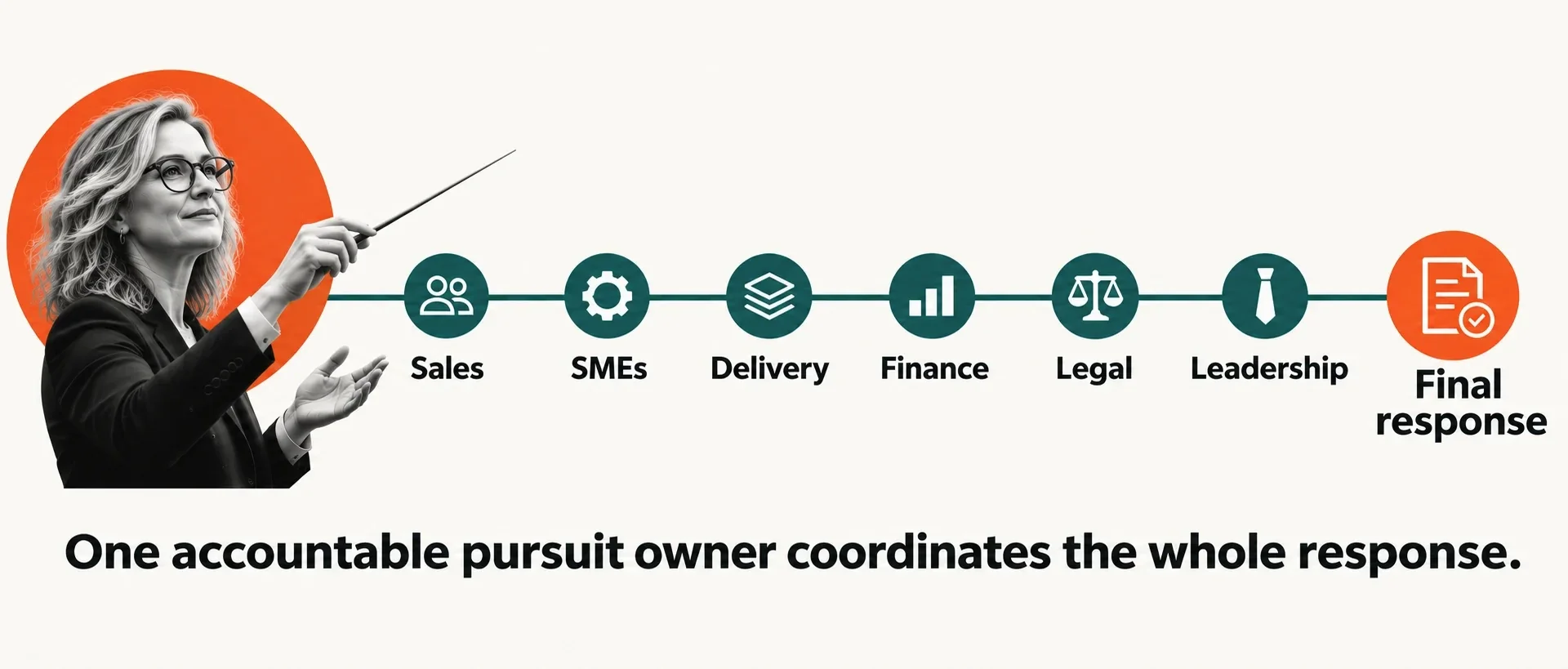
It is not necessarily a knowledge problem. People are measured on selling, delivering, and leading their functions rather than managing an RFP from start to finish. Naming an internal owner without protected time or decision-making authority often transfers the workload without solving it.
Loopio's 2026 RFP Response Trends & Benchmarks Report identifies bandwidth as the leading challenge for proposal teams. That reinforces the case for assigning someone real ownership and capacity, whether inside the company or through a qualified outside partner.
You can free an internal pursuit lead, hire dedicated capacity when volume justifies it, or assign one important opportunity to an experienced outside partner. A freelance writer may add drafting hours; software may organize content. Neither automatically provides both accountable pursuit leadership and complete execution. Full-service support should reduce the burden, not add another supplier you have to supervise.
What should full-service RFP support take off your plate?
Full-service support should establish a clear division of responsibilities. Your team stays involved in decisions and approvals, but does not have to manage the entire production effort.
Your RFP partner manages
Analyzing the solicitation, evaluation criteria, required forms, addenda, and deadlines.
Developing response positioning, win themes, and an evidence-backed writing plan.
Writing the proposal, integrating approved source content, and interviewing SMEs.
Coordinating contributors, review decisions, revisions, and open information requests.
Checking compliance and persuasiveness, formatting the response, and assembling submission-ready files.
Your team still owns
The service, solution, staffing, and technical approach you can actually deliver.
Accurate proof, including approved experience, credentials, case examples, reports, and references.
Pricing, legal and contractual commitments, certifications, and signatures.
Access to decision-makers and affirmative approval of the exact final package.
The distinction is simple: the partner manages the response work, while your team remains accountable for the facts and business commitments it approves.
What does full-service support include from kickoff through submission?
Before hiring, ask what “full service” means at every stage, what will actually be delivered, and who makes the final decisions. The label alone is not a scope of work.
1. Turn the RFP into a managed response plan
A capable partner should examine instructions and scoring criteria, track mandatory requirements and addenda, identify missing information, and establish who owns every important input. The tangible result is a response plan and requirements tracker, rather than just a kickoff meeting. Your team confirms eligibility, decides to pursue, and assigns accountable internal contributors.
2. Decide how to win before anyone starts writing
Strong responses do more than answer questions. They demonstrate why a particular solution fits the buyer's priorities and back that position with evidence. Research, win positioning, a response architecture, and an early approval of the strategic direction help prevent a full draft from being written around assumptions no one agreed to.
At Informed Pursuit, we use a Writer-Ready decision point to confirm the direction before major drafting accelerates. You approve what the solution promises; we turn that direction into a coherent response.
3. Write the full response and coordinate the people behind it
This is the difference between hiring someone to edit finished sections and engaging someone to own the pursuit. Full-service work can include complete narrative development, executive messaging, tailored answers, SME interviews, approved-content reuse, and follow-up on missing evidence. The designated lead keeps decisions and contributors moving, so the client is not left assembling five departments' work.
Ask plainly: “Will you write the full proposal and manage the inputs, or will we be expected to supply finished sections for you to edit?”
4. Manage reviews, revisions, and final quality
The partner coordinates review rounds, resolves version confusion, escalates conflicting feedback, and checks whether the response actually addresses evaluation requirements. Compliance and persuasiveness are different tests: a statement may answer the question while offering little reason to believe it.
Final production usually brings together the narrative, necessary tables or diagrams, approved pricing presentations, attachments, formatting, and submission-ready files. Confirm any unusually complex financial models, extensive graphics, or specialized technical documentation in the scope rather than assuming every possible deliverable is included.
5. Clarify who actually submits
“Submission-ready” is not the same as “submitted.” Some providers handle portal uploads or physical delivery; others hand the approved package to your team. Identify the filing owner, the internal approval cutoff, required credentials or signatures, and what happens if the issuer's portal fails.
For Informed Pursuit's Hands-On engagement, the client submits by default. Electronic or physical submission management can be quoted separately, with explicit client approval of the final files and authorized submission steps.
A simple example: from one RFP question to a finished answer
Imagine a professional-services RFP asking: “Describe your monthly performance reporting and how unresolved service issues are escalated.”
A writing-only provider may expect your team to gather the evidence and hand over approved notes. An independent reviewer can identify what's missing from a draft you've already created.
An integrated pursuit partner tracks both parts of the requirement, interviews the account lead, requests an approved redacted report, drafts the answer, checks consistency with the service model, routes commitments for approval, and validates the final response and attachments.
Your operations leader still approves the actual reporting metrics and escalation promises. But you don't have to personally manage the entire chain from question to evidence to draft to sign-off.
How much time does my team still need to contribute?
Less coordination work does not mean less client accountability. Plan for one sponsor who can make priority decisions, SMEs available for focused questions, a pricing owner, and authorized technical and legal approvers. A strong pursuit partner asks each person for specific information by a clear deadline, rather than sending a vague request to “review the proposal.”
Before kickoff, confirm available source materials, decision-makers, and approval windows. That is essential to a credible schedule.
What if the deadline is close or the response is already underway?
A late start doesn't always rule out help. It changes where effort should go. The highest priorities may be unanswered scored requirements, missing proof, an unclear executive message, or final compliance rather than a complete strategy reset. The provider should review the actual solicitation and progress before committing to a scope or delivery timeline.
Ask for clear milestones, input deadlines, review windows, and a named escalation contact. Also clarify the difference between normal revisions and material changes, such as an entirely new response volume or a new solution direction after approval. No amount of outside support can guarantee a workable schedule when required decisions or evidence are unavailable.
When should you hire, use software, or bring in outside pursuit support?
A permanent hire may make sense when volume supports an ongoing role. RFP software can help a team that already has an owner improve content reuse, tracking, and repeatable workflows, but still takes setup, adoption, and oversight.
For a high-stakes active pursuit, a scoped outside engagement can give you one accountable lead and the writing and production capacity to finish the work now. It isn't necessarily the cheapest choice for every RFP; weigh the opportunity, deadline, internal burden, and expected contract economics.
What does full-service RFP writing support cost, and how should you evaluate the investment?
Starting investment
$10,000
One individually scoped Hands-On RFP Pursuit Support engagement. It includes win positioning, full proposal writing, SME coordination, response management, reviews and revisions within the agreed scope, and a submission-ready package. Your team approves commitments and normally handles submission. The quoted fee depends on complexity, deadline, source readiness, and production needs, not just page count.
One cost rarely appears in the proposal budget: the operational tax. Chasing inputs, reconciling versions, rewriting answers, and escalating decisions consume writer, SME, sales, and leadership time. Without clear pursuit ownership, much of that burden returns with every proposal.
Illustrative commercial opportunity
$250,000 annual contract value.
For a hypothetical technology services company, that is $750,000 total over three paid years, including the first year's $250,000, if awarded and sustained at the same annual value. An award or renewal is never guaranteed.
Potential internal capacity redirected
95 hours, representing $11,250 of hypothetical capacity value.
For illustration, suppose outside support replaces or avoids the following work, based on assumed fully loaded labor rates:
50 hours: writing and production at $70 per hour.
25 hours: SME coordination and rework at $150 per hour.
20 hours: sales and leadership follow-up at $200 per hour.
These are scenario assumptions, not measured client results or guaranteed cash savings. Recovered capacity creates value only when work is genuinely avoided or people can redirect their time.
Revenue is not profit. The $250,000 annual figure is already part of the conditional $750,000 three-year total, so neither should be counted twice or added to capacity value as a guaranteed return. Paying $10,000 does not guarantee an award or revenue.
The useful question is not simply whether $10,000 is a lot to spend on a proposal. It is whether the opportunity justifies one accountable pursuit lead, full writing support, and relief from the coordination work already consuming your team.
What makes the next RFP easier, too?
A strong engagement can leave behind more than final files. Approved content, resolved evidence gaps, and decisions can make the next pursuit easier. Informed Pursuit includes a focused Pursuit Operations Review at closeout, examining the workflow observed during the project and identifying two or three practical improvements. This is not a company-wide audit.
Broader process redesign and automation, when appropriate, are separate engagements. The immediate priority remains the active proposal.
Is Informed Pursuit the right partner for this RFP?
Our role is to take responsibility for the pursuit work, not your business decisions. We clarify requirements, research the buyer, agree on the response strategy, coordinate experts, write and refine the proposal, and prepare the final package for approval. Your team remains the authority on facts, pricing, promises, and final release.
This is a fit for a meaningful opportunity that needs both strategic ownership and writing capacity. If your team has a nearly complete response and only needs an outside assessment, Independent RFP Review may be more appropriate.
Your next important RFP deserves an accountable pursuit owner.
You don't need to commit to a permanent hire or implement another platform just to address the pursuit in front of you. Share the RFP, deadline, what is already complete, and where your team is stretched.
We'll discuss what we can responsibly manage, what your people still approve, and the scope that fits the opportunity. The goal is a stronger, submission-ready proposal, not an open-ended transformation project.
Explore Hands-On RFP Pursuit Support
Related reading: Who Owns the Strategy Behind Your RFP Response? | Independent RFP Review